11/3/09

Identity: the Other Europeans. Jews, Gypsies and beyond...

For the last 2 years I was fortunate enough to be involved in the “Other Europeans,” project based in Weimar Germany with side trips to Vienna and Krakow. You can visit the website set up for the project and it’s attendant seminars and there’s even a site dedicated to the band The Other Europeans itself. Follow the links for back round.

But all you really need to know is that pianist/composer Alan Bern has assembled an amazing collection of some of
(can’t be all of, as I was involved so that sends the curve down a bit) the planet’s greatest “Yiddish” and “Lautari” musicians. Those were the terms that we came up with to describe the musical traditions of the east European Jewish and Rroma communities for our working purposes. Truthfully, the monikers “klezmer” and “gypsy” are a mixture of inaccurate, mal-abused and frankly racist so it was important to name ourselves and control the conversation.

The first year was all about defining within our two separate groups just what was it that made our music either “Yiddish” or “Lautari,” and that was easier said than done. Jewish music had been recorded commercially in Europe since the earliest days of recording technology. But then there’s that “difficult period” as they call it in Germany between 1933-1945, where we lost direct connection to the context in which all this music functioned. Whatever tattered bits that remained was stitched together after wards, Dead Sea Scroll-like had further had to contend with the twin towers of devastation: assimilation into the American fold and the active replication of Hebrew and Israeli culture. Yiddish life fared much worse in that air than anyone could possibly imagine ("That language grates in my ears," Ben Gurion on his mother tongue.) Our Rroma buddies, as devastated as they were too in the fascist roundups, had the meager benefit of a continued context (like, it’s just as bad today for Romani people in Europe as it ever was, for instance,) but were ignored by the recording industry entirely.

Thus we have a decent window on what Jews sounded like a long time ago and we know what Rromanis sound like today, so finding the “core” sounds and repertoire was mighty difficult to say the least. At first we did our separate workshops and put together 2 very fine representative ensembles of each tradition that performed to much acclaim at the KlezMore Festival, the Festival of Jewish Culture and along with 2 concerts 2 weeks of intensive workshops and panels at Yiddish Summer Weimar.

I came home with quite a few of my basic conceits about Jewish music challenged, in a good way I think. I also arrived with a whole new approach to not just Jewish music but music and further, life itself not to be too awful melodramatic about it. There’s just something so positive and edifying to be sitting in a room with some of the no-shit best musicians working on the planet. Being in the musical sphere around Petar Ralchev or Kalman Balogh alone should be life changing if you are paying attention. But then to meet the Moldavian contingent, and to be able to lock in so well both onstage and off WITHOUT ANY COMMON LANGUAGE OTHER THAN PICKIN’? The mind boggles actually.

It pains me greatly, embarrasses me really, that I was unable to find a sponsor to fund my participation in the field work trip to Edinets Moldova, the home of many of the finest Lautaris and one time home of Jewish Clarinet Giant Dave Tarras. Why Edinet, you ask? Well, submitted for your consideration are the two following recordings with roots there. The first, a very well known tune calledHangu lui Nicu Chitac” by the Edinets based Lautari band Ciocarlia. The second, Dave Tarras recorded in the about the same time (late 1950’s) with the Abe Ellstein Orchestra called “Lo Mir Freilachsein.” Hmmm. What do you think? A connection maybe? (oh, can't post the mp3's. email me offline and I'll send them to you.)

For reasons I still cannot properly reconcile, my own Jewish community here in Austin feels not even the slightest connection to this endeavor. And in fact my attempt to raise interest, and hopefully funding, has been met either coplete indifference or even open hostility. “How can we talk even about Eastern Europe right now when there’s so much anti-Israel bias going around…” was a direct quote from one of the folks I solicited for funds. This prevailing attitude in American Jewry belies a further discussion, and we’ll get around to eventually I’m sure. But suffice it to say when even the local Yid’n are not one bit on board with your version of Jewish Life and Culture, then you have a very tough road to hoe indeed.

On a more positive track, this years Other European project, ironically funded by the EU no less, included a Winter rehearsal in Weimar where the two ensembles attempted to meld into some kind of cohesive orchestra and explain musically our research. The sessions, in the middle of a frozen German February, were grueling and difficult. But the end result, highlighted by an amazing concert, was more than I had hoped for.

We gathered again in Vienna in July to further rehearse and then share our research if you will with concerts at the same three festivals we played last year. If it was even possible, these concerts were way beyond what I think any of us could have anticipated, and the performance in the Reform Synagogue in Kazimerz (Krakow, Poland) was one for the books; possibly a personal best thus far. Luckily for all of us, the concert was broadcast on television and is archived in streaming format here.

What are we to gather from all this?

I’m still processing it I must admit. Searching clumsily for analogies at a seminar, I proffered that the Yiddish and Lautari music’s were at one time drinking from a very similar well, with our communities close in both cultural and physical proximity. Marin Bunea reminds us that these music’s exist devoid of a required nationality or religion. In Edinets, he relates, the finest regarded Lautari was in fact a Jew and vice versa. But much in the same way that Bluegrass* music took off as a hyper-charged, polished and citified version of it’s more unsophisticated Old Time Country roots, Lautari music exists today in the same sort of context: concertized, virtuosic and harmonically advanced. Poor little Yiddish music remains stunted, attached more to the simcha and dance traditions and much like Old Time played today, devoid of it’s life giving context played by musical recidivists as if it’s a Jewish "Civil War re-creationist music." Or worse still, used only as a name checked home base of style and repertoire, used to create some kind of clumsy admixture using Yiddish melodies as a Tabula Rasa for whatever the artist (usually someone unable to enter the music business any other way strangely enough) wishes to project. Insert one of literally HUNDRED’s of acts in either slot. It’s OK. We have plenty of time…

That all said, I think that now is as fine a time to note that I’m pretty much done with attempting to make people agree with my take on Jewish music anymore. It's tiring and evidently ineffective. I’ll take a gig when they come, but my personal identification as a “klezmer” (oh how I do despise that term!) musician has thus concluded. I walked away from a popular and commercially successful music group almost a decade ago, in no small part to better devote myself to the reconstitution of Yiddish and other traditional music’s. But as anyone who has been working in this field could tell you, it’s not a parnossa. I reckon I made more scratch playing my own music for 90 minutes last week than Michael Winograd banked all last year. And he’s friggin’ great. And he’s only one of about three dozen amazing cats I know who have done the hard work and play the good music, with wit and skill. But what they didn’t learn, as they were way too busy learning music and culture correctly, was how to hustle a a good paying gig and write a grant that appeals to the current version of mainstream Jewish thought.

But that’s the environment we find ourselves in today, and I feel that I’m personally unable to in my opinion degrade this music, any music actually, to the level that is currently required to operate effectively. Frankly, I feel the same way about Bluegrass, the music of my upbringing as well; I just can’t reconcile what it has become today with what I know to be my own experience.

Ultimately, I think we get the culture that we deserve. I have no children, so ultimately I have no dog in this hunt. And I plan on having a much more care free life now that the "why don't you to think like I do" portion of my career has now thankfully concluded.

*I wish to go on record that Zev Feldman called my analogy “brilliant,” but only after he amended it.

10/28/09

Henry Sapoznik: "Youngers of Zion" CD sales to benefit Mark Rubin

From Ari Davidow's Klezmer Shack:

This just in: Hank Sapoznik has announced that all sales of the "Youngers of Zion" CD will be earmarked to Mark Rubin's rehab fund. For those of you who missed my post on the Jewish-Music mailing list about YOV (perhaps more truthfully named "middle aged agents of Katz's deli" or somesuch) being a great place to get a Mark Rubin fix, here's what I wrote back in 2005:

I don't even know what to say about this. The album cover says it all, but you'll have to read the review to know how I heard it. Henry Sapoznik, with Austin's musical ambassador, Mark Rubin, and the absolutely stunning fiddle of Cookie Segelstein, teamed up to bring us the one and only Youngers of Zion / Protocols. Listen or else.

Since you are here, now, let me encourage you to purchase this delightful CD from cdbaby.com before you go elsewhere. Or, if you already have the CD, you can help the Mark Rubin fund, directly.


10/17/09

From the Archives: review of the George Jones re-issue "The Grand Tour"

From No Depression Magazine, Issue #70 July-August 2007

George Jones – The Grand Tour


9/8/09

What I really should have said...

Seems a lot of folks have been approaching me lately about Eastern European music here in Austin. I can see why too, as I've been playing Jewish Dance music (aka "klezmer') here and abroad since I first moved here in 1989. I don't wish to sound entirely discouraging about it, but a person's intentions completely speak to the end product. And my life in folk music has been shaped by the people who I learned from. Who were, trust me, far less amiable in expressing these concepts that I.

As I return tonight from a weekend of work in NYC with Jewish clarinetist-Bluegrass mandolinist non pareil Andy Statman, the ad hoc Balkan Brass Band Veveritse and others, I'm starting to formulate a handy FAQ on why maybe I'm not the guy you want to talk to.


a) I personally have no interest in playing music outside of its intended context.

As much as I enjoy listening and playing, lets use simply as one example, Romanian Lautari music, the simple fact is that there isn't anyone here in Austin TX who wants to hear it. If there is no wedding, no christening or restaurant gig, then why take the time and energy to crank out a low grade version to play in front of audiences that wouldn't be able to discern the difference between no good and no, good! Submitted for evidence: What I've found in my many years in this community is that the Jews of Texas, a mighty fully assimilated bunch of folks, don't much care for the kind of Jewish music I play. It's attached to Yiddish speaking culture that they either can't remember or in the case of fervent Zionists, reject entirely. Thus, I don't get any calls to play simchas here, even though after over a decade of study the musicians I work with locally are as competent and fine as you'll encounter anywhere. There's just no demand for the service I provide here. I do get work every where else there is a culturally active Jewish community, say like the East Coast (who would have thunk?) and without much irony, parts of Europe where it never existed in the first place.

Many years ago, I became entranced with the Oud and the sounds of the Magreb and points East. I sought out a teacher, which is what you are supposed to do when you wish to really learn something. But he wouldn't show me a thing on the instrument, not how to tune it, nothing, until I explained myself. Why, he inquired, do you want to play the Oud? It is not your music. There is no possible way you will ever understand the music it makes, he explained, as it takes the study of a lifetime to comprehend not only the tonalities but the purpose and context in which the instrument exists. It was not until I had outlined my goals completely, and to his satisfaction, that he started my instruction. (For the record, I told him I was interested in the Oud only where it intersected with Western cultures, in the form of the Greek Oriental Rembetika tradition which has historically informed the Hassidic and other Eastern European Jewish music's of which I had made a decade long study at that point.) I have a feeling most of these young kids playing folk music today have never been challenged in that way. And more's the pity.


b) "Coals to Newcastle"

Here in Texas we have AMAZING living music traditions, with Tejano, Tex-Polish, Tex-Czech and French language music’s all indigenous to the region. Shuffle blues, honky tonk, Texas swing, white folks got some great music here too.

Who, really, moves to Austin TX to play Balkan music? Someone who wants to be as far away from the Balkans, and anyone who could call out a charlatan as possible, that's who. What possible explanation can you conclude?

There's a whole tribe of "New Orleans" jazz musicians who reside and work here in Austin simply because they possess neither the skills or stomach to actually go to New Orleans where, strangely enough, there is a built in demand for New Orleans Jazz. It's far more comfortable to sit 8 hours to the west and not ever have to see if you really could “make it” in the proper context. Bluegrass lives in Tennessee. Be-Bop and Free Jazz in Chicago and New York. Balkan music lives in the Balkans and when you drink this far from the well, the water is mighty foul indeed.

Conversely, Texas music has changed the world, and people leave their homes and lives elsewhere every day to come here and take it in. Personally, it's idiotic not to soak it all up, as it flows from the tap here. If, that is, you have the ears to hear it.

c) Personally, there are few things more ignoble than a cultural dilettante.

I won't go into the whole flaming screed, but I strongly suggest you pick up a copy of Hank Bradley's amazing essay "Counterfeiting, stealing, and cultural plundering
A manual for applied ethnomusicologists." He makes my argument, but without the bitter recriminations that I am famous for. Suffice it to say that when someone not of a culture approaches me about playing music of a culture, the only thing I could think of is "what is it about yourself and your own people that you find so distasteful that you feel the need to suck off some one else's'?" Over the years, I've been shown some amazing examples of historical dissonance that has tempered my tone quite a bit. But I think you get my point.

d) Play "with," not "like."

Music is fun. It's amazing and wonderful and healing and a conduit to the ineffable. But music is simply just one small facet of a greater diamond that represents a culture, and thus can also be precious and fragile. I don't begrudge anybody a gig; if you want to call yourself "gypsy-punk-klezmer-balkan-circus" whatever all you like. It's a free country. But I prefer to play Lautari music with actual Lautari musicians in situations where they expect Lautari music to be played. And the simple truth is: you could too. All you have to do, as LBJ famously remarked, "is everything you have to do." Life is WAY TOO SHORT to be screwing around, people. Get out there and do it, not some lame half-assed version of it.

Playing a watered down, second rate version of a beautiful musical tradition far removed from its context and community with like minded hobbyists isn't going to get you anywhere.

Not ever.

(See my Manifesto for a New Year, dated 2007 for even further context on music and intention.)

BTW: there are these planes. And they fly everywhere, nearly everyday.

8/21/09

A note on success in the market place from Danny Barnes.


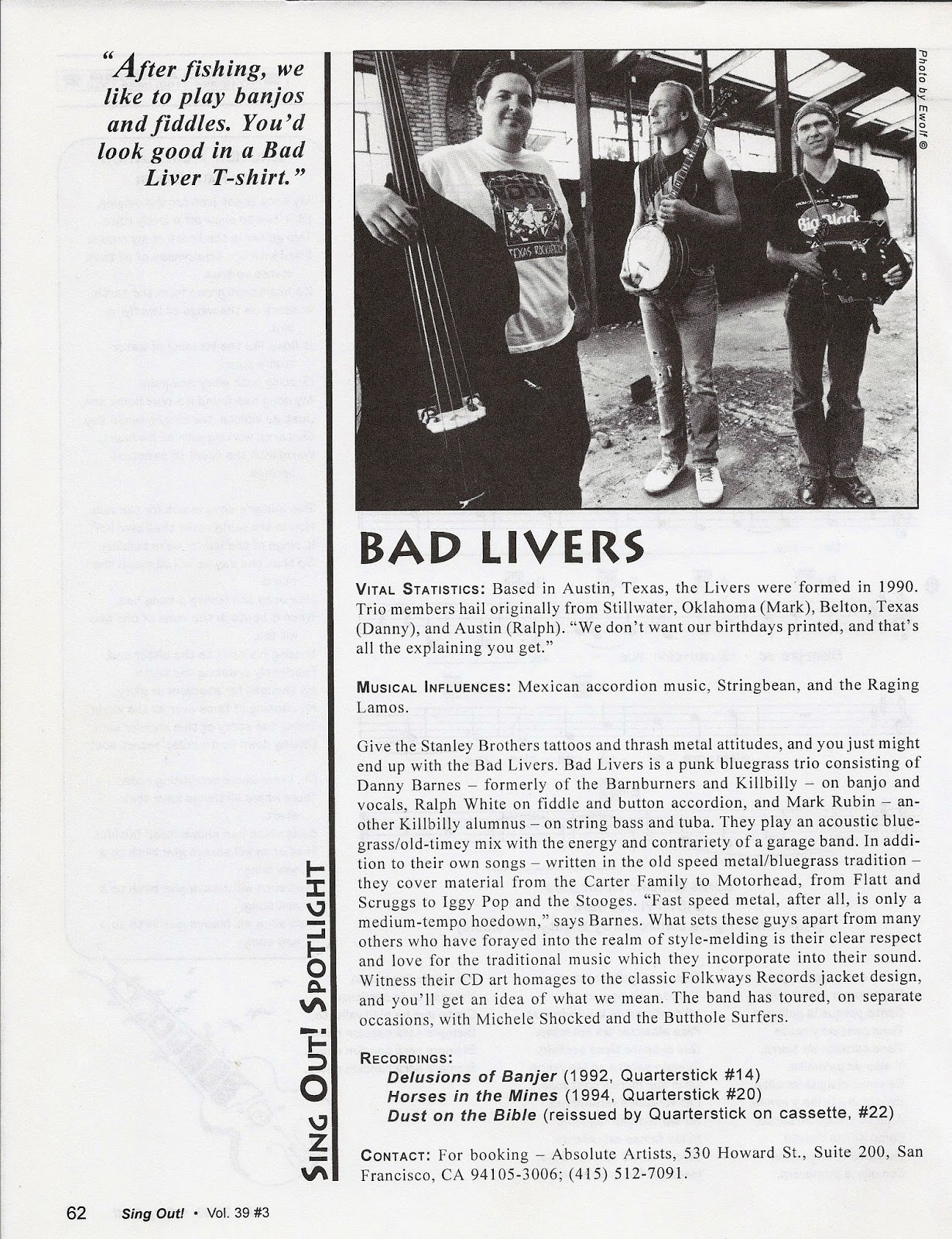
In the last year or so I have kept up a daily communication with my old business partner and "Fearless American Weirdo" Danny Barnes. It's been a wild mix of medias: iPod pics, tetxts, emails and YouTube links. We hardly speak in fact except at the odd Bad Livers reunions (next one and last one on the books, Novemeber 20, Old Town School of Folk, Chicago IL, double bill with the Hot Club of Cowtown.)

Here's a typical chestnut of wisdom from him:

"the stanford research institute says that the money you make in any endeavor is determined only 12.5 percent by knowledge and 87.5 percent by your ability to deal with people."

later another quote is "what you will become in five years will be determined by what you read and who you associate with."

Frankly, that explains a lot to me!!

Here's one of the many bands he's been hipping me too as well:


Danny's got a new CD coming out in the fall, and it's a breathtaking master work. No foolin'. Check it out.


7/30/09

Brian Marshall delves into Texas Polish-Jewish Connections

"If it had not been for a Jewish merchant we could have ended up in New Jersey or some other God awful place!!!!!!"

That's the email title I got from Texas Polish Dance Band Fiddler Brian Marshall, and it's meant as a compliment. Evidently he's found that his kin folk, along with most of the second wave of immigration of Texas Polonia were encouraged to move to Texas by one James Meyer Levi, a Polish Jew and Confederate Civil War Veteran.

He continues: "New Waverly, Texas, is located thirteen miles south of Huntsville on State Highway 75 and Interstate Highway 45 in southern Walker County. The Houston and Great Northern Railroad Company founded it, after the residents of what became Old Waverly refused to grant the railroad a right of way through their community. A group of Walker County cotton planters met in a general store at Old Waverly, Texas on September 19, 1866, to discuss their problems in securing workers. Meyer Levi, a merchant who had various holdings in the state, owned the store.

There were twelve planters who gathered at the meeting for the purpose of recruiting laborers from Europe. The members established themselves as ‘The Waverly Emigration Society” and commissioned Meyer Levy to travel to Europe to recruit 150 “foreign laborers” to work on their lands. Each planter requested a certain number of workers with specific skills. The planters agreed to play for the passage of the immigrants to Texas and to play the men $90, $100, and $110 for their work in their work in their first, second, and third years in America. The women would receive $20 less for their labors each year. Meyer Levy agreed to go to his native Poland and recruit workers. Forty-five families totally 143 persons arrived in New York on April 9, 1867. After a short difficulty with travel funding, they then traveled by ocean from New York to Galveston, Texas.

In 1870 the Great Northern Railroad Company laid its’ tracks ten miles west of Old Waverly and set aside a town site know as Waverly Station. The new community attracted many residents of Old Waverly, and the new town’s name was soon changed to New Waverly. Because so many of the original group of Polish immigrants followed to New Waverly it was called the “Cradle of Polish Immigration” in this part of Texas. While most of the first Polish immigrants made their homes in New Waverly, many eventually migrated to the surrounding counties."

Visit Polish Texans website for more information about this fascinating Polish Diaspora community.

6/16/09

There's Way Too Much On YouTube...

..that you may have missed. I find it, and share it with you so you can have a productive life.

Here's a collection of music in it's most natural state, in context and live. Hope you enjoy.

From a Serbian bar, here's Aca Nikolic Cergar:


Serbia again, looks like a backstage rehearsal at the Guca Festival with Demiran Cerimovc Orkestar, that year's winner:

Another Guca favorite, Vranjski Biserli playing a very upbeat Edersedzli on a morning talk show

Here's an inpromyu street jam with some out of towners in Vranska Banja, home to many fine brass band players in Serbia. Come with me now to old Mexico, the State of Sinaola in fact, home of the big brass Bandas. Sit in on this rehearsal of Banda Libertad de Guamichil (and dig the tuba player who kills it!)

Follow me down to the beach with the Buccaneer Band of Mazatlan.

Here's a Son Jarocho band tackling one of my all time favorite numbers, El Cascabel! In my heaven, harps sound like this:

Well, I think this is what happens when two ditsy French chicks pick up a couple of Romanian Lautari and head back to the hotel. I think...

Here's what looks to ba a social gathering of some sort in Romania, street music provided by the Fanfara din Toflea.

Further East, at least I think, here's the scene at a Moldavian Wedding. Screw the band, let's see those dancers. Sirba!!

Ah, the mariachis of Romania. A little table music?

Here's as fine an example of a Romanian a village taraf as you will find. This could have been filmed 100 years ago.Cristi Geagu Catâroiu on lead violin.

Welcome to the living room of the Pavlovic Family, where daddy Branko plays the hell out of the brac!!

We all owe a great debt to these folks wwho are giving these little glimpses into their world. Hopefully with technology like this, we can put aside the lie of otherness between peoples and we can finally recognize everyone as brothers in the family of man. That's my dancing prayer.

Today we speak of Gabi Lunca.

It's a well documented fact that I'm totally nuts about Lăutari Music from Romania and points east. As I prepare for another adventure to Europe with the Other Europeans project, I have been diving back into that rich repertoire for yet another listen. Marin Bunea, the legendary Moldovan fiddler on our tour, is like me entirely entirely enraptured in the music of singer Gabi Lunca.

There's a fine biography of her posted here, noting all the amazing musicians (the Gore Brothers, Toni Iordache, ect..) and of her rivalry with the equally amazing, if not more rough and tumble sort of singer, Romica Puceanu. But watching how she looks at her accordionist when she drops the mic down to his bellows when he solos, you don't need to be told that she was married to him!

Enjoy!

This one was a mind blower. Fans of the music of Dave Tarras will note the melody and form is identical to his tune "Gypsy" from the the amazing Columbia LP TANZ!

Here's one of those amazing "lazy 3/8ths" tempos that Romanian musicians are world famous for.